English
 French
 Spanish


Why ‘When’ You Sample Often Matters More Than ‘Where’
Environmental Monitoring Programs (EMPs) are widely accepted as a cornerstone of preventive food safety systems. Facilities invest significant effort defining zones, selecting organisms, validating methods, and training teams yet many EMPs fail at one critical dimension:
Scheduling
Sampling schedules are often treated as an administrative task rather than a scientific and risk-based decision. As a result, facilities may proudly report years of “negative results” while still missing contamination because they’re sampling at the wrong time.
EMP scheduling answers one fundamental question:
Are we sampling when contamination is likely, or when clean results are easiest to achieve?
This article explains the role of scheduling in Environmental Monitoring Programs, highlights common loopholes in traditional sampling schedules, and shows how risk-based timing can significantly improve contamination detection.
What Is Scheduling in an Environmental Monitoring Program?
In the context of environmental monitoring, scheduling is not just deciding how often to sample. It is the deliberate planning of:
- When samples are collected (time of day, production stage)
- Under what conditions (before cleaning, after cleaning, mid-run, changeover)
- In what sequence (rotations, targeted vs random)
- In relation to events (maintenance, shutdowns, deviations)
In essence, scheduling defines the probability that contamination, if present, will actually be detected.
Common loopholes in traditional EMP scheduling
Many schedules accidentally avoid the moments contamination shows up. Typical pitfalls:
Sampling at fixed, predictable times
When samples are always taken at the same time (for example, every Tuesday morning), teams and processes naturally adjust. Areas look better than usual, which lowers the chance of finding real issues.
Sampling only after cleaning
Post-cleaning samples confirm that sanitation was done, but they don’t tell you whether contamination was present during production. This turns EMPs into cleaning checks rather than detection tools.
Avoiding high-risk production moments
Sampling is often skipped during busy periods like peak production, changeovers, or maintenance days. Ironically, these are the exact times when contamination is most likely to spread.
Relying on rigid calendar-based frequencies
Rules like “sample Zone 2 once a month” assume risk is the same every day. In reality, some shifts, days, and operating conditions carry much higher risk than others.
Why Timing Is Critical to Detect Environmental Contaminants
A simple rule of thumb in food safety EMPs:
Environmental pathogens and indicator organisms are most detectable when they are disturbed, mobilized, or freshly transferred.
Real-world examples:
- Listeria is more likely to be detected during or after wet operations
- Salmonella risk increases during raw material handling and dry dust movement
- Indicator organisms spike during start-ups, shutdowns, and changeovers
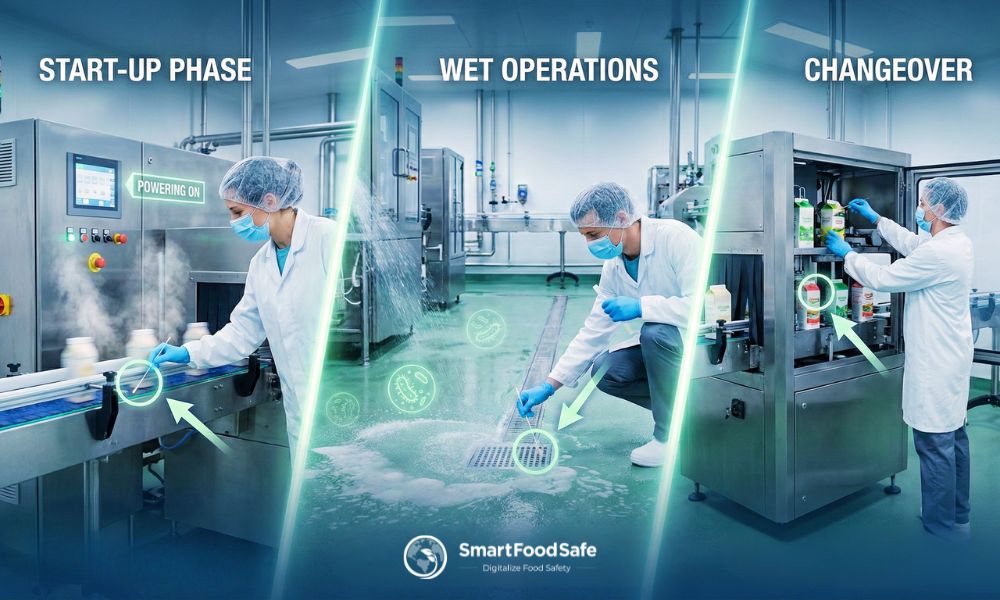
Sampling outside these windows creates a false sense of control.
How to Build an EMP Sampling Schedule That Actually Finds Risk
An effective scheduling design intentionally samples during maximum risk moments, not maximum convenience.
1. Plan Sampling Around How Your Process Runs
Instead of locking sampling to specific dates, tie it to how your operation actually works. High-risk moments often include:
- Start-ups and shutdowns
- Mid-production, once equipment has warmed up
- Product changeovers
- Long or extended production runs
- Restarts after maintenance
Sampling during these phases better reflects how and when contamination is likely to occur.
2. Use Multiple Sampling Timings
Relying on a single sampling moment leaves gaps. A more effective EMP spreads sampling across different stages of the day:
- Pre-operational sampling helps identify lingering harborage before production begins
- Operational sampling captures active movement and spread during production
- Post-operational sampling confirms that sanitation was effective
Together, these layers give a more complete picture of risk.
3. Avoid Predictability With Controlled Randomness
When teams know exactly when sampling will happen, behavior changes. Introducing some level of unpredictability helps capture real conditions:
- Rotate sampling across shifts
- Vary days of the week
- Sample under different production conditions
This reduces bias and makes results more meaningful.
4. Increase Sampling After High-Risk Events
Sampling frequency should temporarily increase after events like:
- Equipment repairs or facility construction
- Drain backups or water-related incidents
- Positive environmental findings
- Changes in suppliers or raw materials
- Process deviations
Ignoring these moments can leave emerging risks undetected.
5. Match Sampling Timing to Your Zoning Strategy
Different zones behave differently and should be sampled accordingly:
- Zone 1: Often best sampled during operations or immediately after product exposure
- Zone 2 & 3: More effective during peak traffic and equipment movement
- Zone 4: Sample during heavy personnel movement or wet conditions
Applying the same timing logic to every zone can weaken the program.
What NOT to Do in EMP Scheduling: Common Mistakes
❌ Sampling Only When It’s Easy
If sampling avoids operational disruption, it likely avoids risk too.
❌ Designing Schedules to “Look Good” for Audits
Auditors are increasingly skeptical of EMPs with years of perfect results. A lack of findings may indicate poor scheduling, not excellent control.
❌ Treating All Weeks and Shifts Equally
Night shifts, weekends, and overtime runs often carry higher risk due to:
- Reduced supervision
- Temporary staff
- Modified cleaning practices
❌ Never Revisiting the Schedule
If your process, products, or equipment change but your EMP schedule does not, your risk assessment is outdated.
❌ Sampling After Teams Have “Prepared” the Area
Advance notice defeats the purpose of environmental monitoring as an early warning system.
What an Effective EMP Looks Like
A mature environmental monitoring program isn’t judged by the absence of positives but by its early, meaningful detection that enables corrective action before a product is affected. Good scheduling turns EMPs from a compliance checklist into a predictive risk-management tool.
Benefits of smarter scheduling:
- Earlier detection of contamination
- Deeper, more accurate root-cause analysis
- Fewer production surprises
Stronger confidence in preventive controls
How Technology Closes Scheduling Gaps
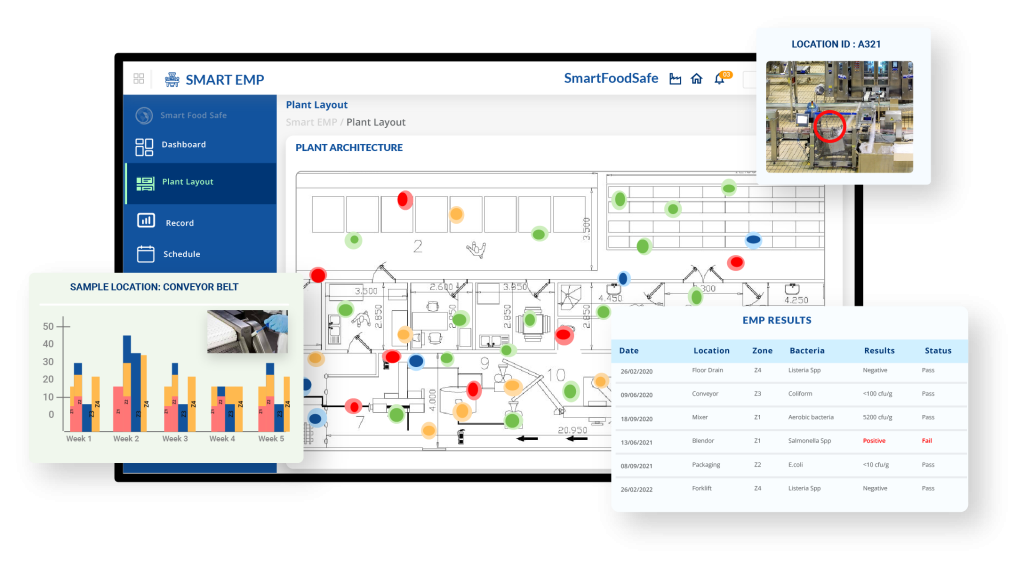
Modern environmental monitoring software plays a key role in fixing scheduling gaps. Tools designed for risk-based EMP sampling can trigger sampling based on real production events. For example, Smart Food Safe’s Smart EMP module is purpose-built with features to:
- Trigger sampling around start-ups, changeovers, post-maintenance, wet operations, and corrective actions
- Automate schedules and role-based notifications across shifts and sites
- Use trends to adjust sample timing and intensity
For food safety leaders serious about improving detection and strengthening preventive controls, it’s time to move beyond fixed, calendar-based schedules.
See how Smart Food Safe’s Smart EMP module enables dynamic, real-time scheduling aligned with operational risk.
Request a demo and experience how smarter timing transforms your Environmental Monitoring Program.