English
 French
 Spanish


How do you clean a facility built around dry foods, when introducing water can actually make things worse?
It’s a real balancing act. Despite being dry by design, low-moisture foods have been linked to the majority of Salmonella outbreaks over the past decade. Even powdered infant formula, one of the most tightly controlled products, was involved in deadly Cronobacter cases in 2022. If microbes can’t grow in dry foods, why do they keep showing up? The answer lies in the environment and how it’s cleaned.
Dry sanitation, a cleaning method that eliminates harmful microbes without using water. Let’s dive into the science of dry cleaning, why it’s crucial for low-moisture foods, and how modern tools (like environmental monitoring software) make it more effective.
What Is Dry Sanitation?
Dry sanitation means cleaning and sanitizing equipment without water. Instead of hoses and spray bottles, workers use brushes, vacuums, and low-water sprays to remove soil and kill microbes.
For example, a belt conveyor in a cookie factory might be brushed, wiped with 70% ethanol, and then heat-treated, rather than power-washed.
By definition, low-moisture foods have very little water (water activity ≤ 0.85). In such environments, dry sanitation is essential: any added water can suddenly create a breeding ground for pathogens.
How Pathogens Survive and Spread in Low-Moisture Food Environments
Low-moisture foods such as flour, nuts, spices, and powdered products do not support microbial growth but they are not risk-free. Pathogens including Salmonella, Cronobacter, Bacillus cereus, and Listeria monocytogenes can survive for long periods in dry environments, persisting on equipment, in dust, and within hard-to-clean areas without multiplying.
Outbreak data continue to confirm this risk. Despite low water activity, dry foods account for a disproportionate number of recalls, with Salmonella responsible for most reported incidents. The challenge is not growth in the product, but long-term survival in the processing environment and eventual transfer to food.
Contamination in low-moisture facilities typically enters through environmental routes like raw ingredients, employee movement, tools, airborne dust, or traffic between wet and dry zones. Once present, pathogens often remain unnoticed until moisture is introduced.
Water, though associated with cleaning, can quickly become the greatest risk. Industry guidance warns that even small amounts of moisture from condensation, leaks, or improper wet cleaning can mobilize dormant pathogens and spread them across surfaces. Dry sanitation preserves low water activity, keeping environments inhospitable to microbes. When moisture enters, that protective barrier breaks down, increasing contamination risk.
Wet vs. Dry Sanitation: Key Differences
Typical wet cleaning uses water, detergent, and rinses to wash equipment. By contrast, dry sanitation swaps out the water.
- Physical cleaning: Instead of hoses, crews use brooms, brushes, microfiber towels, and HEPA vacuums to sweep or scrub away debris.
- Dry sanitizers: Waterless chemicals are used. Common choices are 60–90% alcohol-based sprays or wipes, which evaporate rapidly. These disrupt cell membranes and leave surfaces almost dry.
- Alternative methods: Technologies like UV-C light, ozone or chlorine dioxide gas, or superheated (very low-moisture) steam can sterilize equipment surfaces without wetting them.
Why go dry? Because in a bakery or nut plant, water is literally the enemy. Wetness can drip into cracks or spread via aerosols, helping pathogens take hold. For example, hosing down a large stainless tank might leave a puddle in a scratch or valve. Instead, workers vacuum and scrub it dry.
In a nutshell, wet sanitizers kill bugs but add water; dry sanitizers kill bugs without adding water. Both the CDC and FDA acknowledge that in dry-food plants, controlling moisture is as important as killing the germs themselves.
Dry-Cleaning Techniques and Tools
Dry sanitation uses a toolkit of physical and chemical methods. Key approaches include:
- Brushing and scraping: Stiff brushes, scrapers, and pads dislodge caked-on flour, grains, or sugar.
- Vacuuming and air jets: High-power vacuums or compressed air blowers remove fine dust from conveyors, hoppers, and equipment crevices.
- Alcohol wipe-downs: Spraying or wiping surfaces with ~65–90% ethanol or isopropanol rapidly kills microbes. Codex explicitly recommends alcohol sanitizers for dry environments. These solutions evaporate quickly, so no rinse is needed.
- Dry steam and hot air: Injecting superheated steam (low-moisture steam at ~85–100°C) or circulating hot air can denature proteins and kill bacteria on contact. Longer exposure (for example, 150°C for several minutes) may be used for heavy-duty sanitation.
- UV-C and pulsed light: Ultraviolet lamps or pulsed xenon flashes disinfect exposed surfaces without chemicals. They work best when dust does not block the light.
- Gaseous sanitizers: Fogging or circulating ozone or chlorine dioxide gas can decontaminate rooms or equipment, penetrating areas that wipes cannot reach.
- Innovations (oil or fluid flushes): Some facilities run hot oil or dry grains through lines (a “material flush”) to push out sticky residues. Research is also exploring organic acids delivered in oil emulsions to avoid alcohol’s flammability.
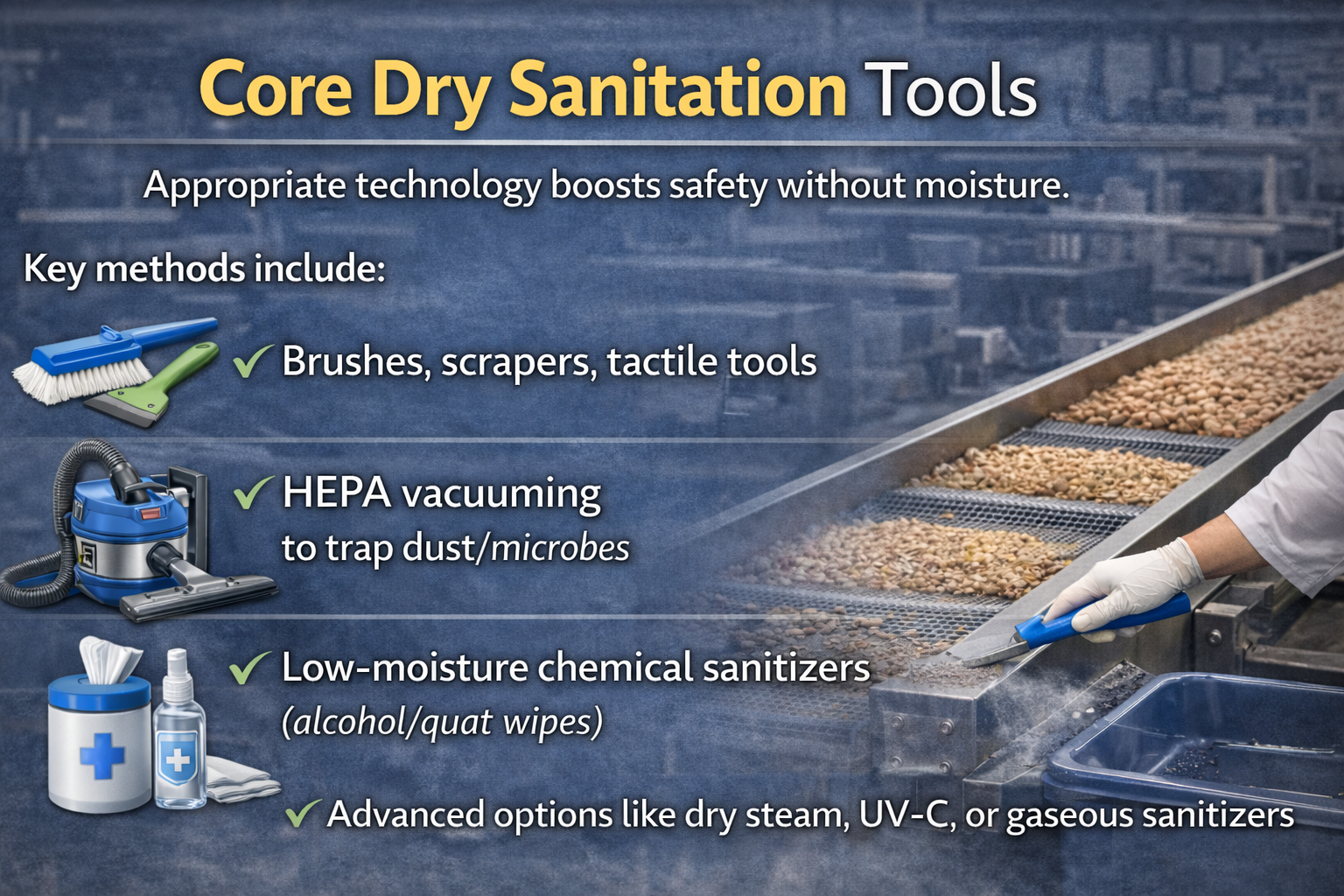
No single method is a silver bullet. Facilities often combine techniques, for example vacuuming to remove debris, followed by an alcohol spray, and then a UV pass or hot air treatment. The Codex Guide for Control of Salmonella in Low-Moisture Foods explicitly recommends validating any dry sanitation process used.
Digital Tools: Environmental Monitoring Software & SmartEMP
Cleaning is only half the battle; you need to prove it worked. That’s where an Environmental Monitoring Program (EMP) comes in. Modern facilities increasingly use specialized EMP software to manage this.
According to FSNS, a well-designed EMP is “your frontline defense against contamination,” helping “identify potential contaminants… [and] validate the efficacy of your sanitation processes”.
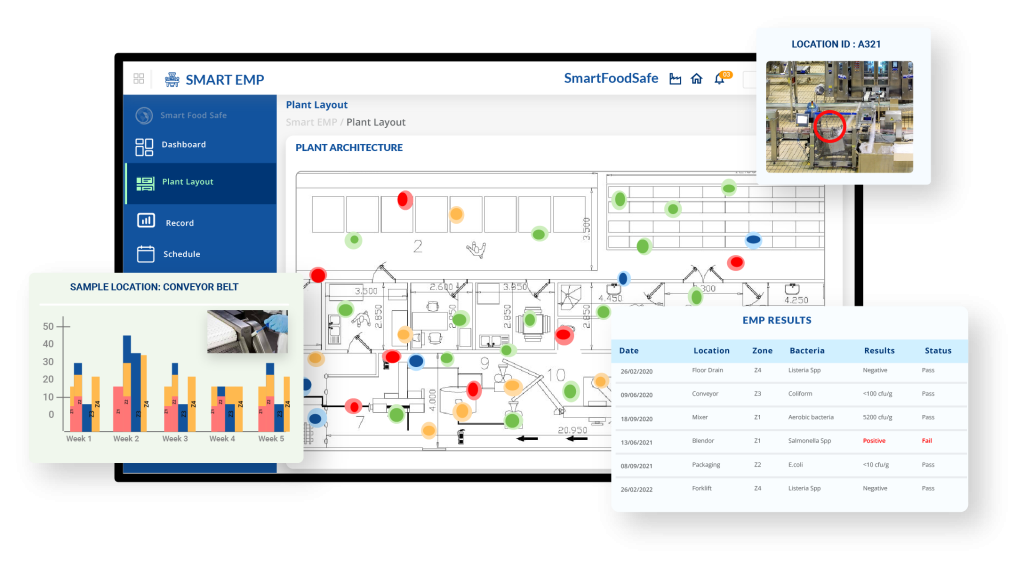
In practice, software like SmartEMP lets you digitally map your plant, define risk zones, and schedule swabs on a rotating basis. When a technician swabs a mixer belt, the result is logged in the system. If it’s positive, the software flags it, assigns corrective actions, and suggests follow-up tests.
All this data is available on a single platform. Modern digital tools help plant teams see environmental sample points and risk zones at a glance, using real-time maps and alerts. This allows teams to catch problems early and trace them back to root causes.
As one industry article summarizes, these digital tools help turn environmental data into real action, enabling continuous improvement. In short, leveraging environmental monitoring software makes dry sanitation more reliable by closing the loop between cleaning and verification.
Benefits of Dry Sanitation
When done right, dry sanitation offers major advantages for low-moisture processing:
- No water waste: You save on water use and wastewater treatment. There’s no wet sludge to clean up and no slow drying times.
- Less microbial spread: Without puddles or residual moisture, you eliminate a key vector for pathogen growth. This directly reduces the risk of Listeria or Salmonella establishing on the line.
- Product quality: Many dry foods (baked goods, cereals, seasonings) would clump or spoil if exposed to water. Dry methods preserve texture and flavor.
- Cost and eco-impact: Dry sanitizers tend to be waste-free and low-residue. Reviews note that dry cleaning methods are often “environmentally friendly and typically low cost”. You avoid heating large volumes of water and reduce overall chemical use.
- Facility design and safety: Lower humidity means less corrosion and fewer damp niches for pests. Floors stay dry (safer for workers), and less chemical handling is required.
- Regulatory alignment: Regulators increasingly recognize moisture control as a preventive control in dry-food plants. A “war on water” approach aligns with FSMA and industry codes, demonstrating proactive risk management.
Challenges and Considerations
Dry sanitation is powerful, but it’s not without hurdles:
- Efficacy worries: Some managers worry dry methods won’t kill as thoroughly as a soak. Not every sanitizer is 100% effective on tough soils or biofilms, and incomplete cleaning can leave residues that later harbor microbes.
- Flammability and safety: Many dry sanitizers, such as ethanol and isopropanol, are highly flammable. They require careful handling, and machinery often must be shut down and cooled before spraying to avoid fire risks. This can limit cleaning frequency and has driven research into oil-based alternatives.
- Equipment wear: Physical cleaning tools like brushes and scrapers can scratch or mar surfaces. These micro-scratches can become harborage sites for bacteria, making sanitary equipment design and gentle techniques critical.
- Labor and training: Dry cleaning often requires more manual effort and higher skill levels. Workers must be thorough, reaching every crevice, and cleaning must always meet the defined sanitary objective and be verified.
- Lack of standard protocols: Unlike wet clean-in-place (CIP) systems, many dry sanitation processes lack industry-standard procedures. Reviews call for more research and standardization of doses, contact times, and validation methods. Until then, companies must carefully develop and validate their own SSOPs.
Because of these challenges, most processors do not completely abandon water. In rare cases, tightly controlled wet cleaning, such as a brief spray or steam flush, may be used for stubborn residues, but only with extreme caution.
Conclusion: Why Dry Sanitation Is Still a Better Choice
For facilities handling low-moisture foods, dry sanitation is often the best choice. It aligns with the science: by eliminating excess water, you remove the core growth factor for pathogens. Many studies now agree that dry cleaning can be “a feasible alternative” that is both greener and cheaper.
In practice, an effective dry sanitation program, augmented by smart environmental monitoring, can outperform a wet wash in these settings. It protects product quality, saves resources, and prevents the very conditions that allow Salmonella or Listeria to thrive. In the battle for food safety in dry-food plants, going dry is a winning strategy.
Key Takeaway: By “waging a war on water,” manufacturers can achieve higher safety, sustainability, and consistency. When done right, dry sanitation emerges as the superior defense against contamination in dry-food environments.