English
 French
 Spanish


We’ve all heard the phrase “clean enough to eat off of.” But in professional food processing, healthcare, and controlled manufacturing environments, clean isn’t something you eyeball. It’s not about shiny surfaces, clear water, or the absence of odor. It’s about measurable, repeatable scientific outcomes.
Effective sanitation depends on the precise interaction of thermodynamics, molecular chemistry, and microbiology. When these elements are correctly balanced, sanitation becomes predictable and repeatable. When they are misunderstood or ignored, risk increases—sometimes invisibly.
At the center of this science lies a foundational principle that governs every successful cleaning process: the Sinner’s Circle.
The Sinner’s Circle: The Four Variables That Define Clean
Sanitation effectiveness is determined by four interdependent factors:
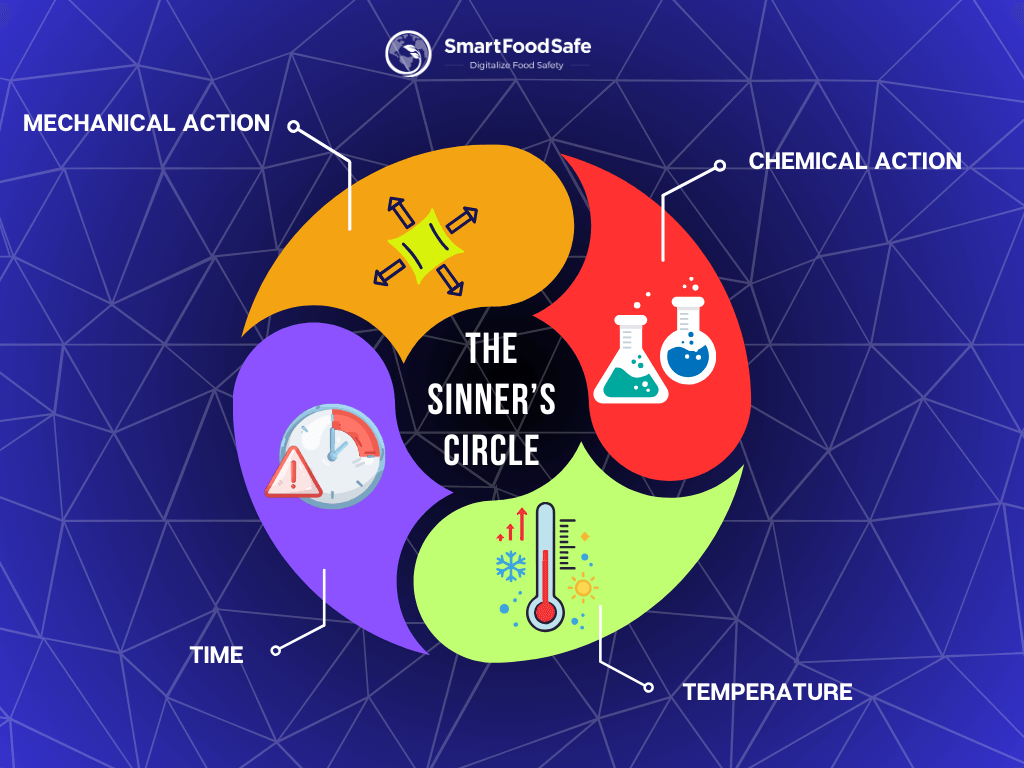
The elements that form the Sinner’s Circle
These elements form the Sinner’s Circle. No single factor works in isolation. If one variable is reduced, the others must increase to compensate. Lower water temperature, for example, demands longer contact time, stronger chemicals, or greater physical force.
This balance explains why shortcuts in sanitation rarely work. Removing one element without adjusting the others breaks the system. Clean, therefore, is not achieved through effort alone, but through controlled balance.
Understanding Soil: Why Chemistry Matters
Not all contamination behaves the same way. In sanitation science, residue is referred to as soil, and each type requires a specific chemical approach.
Protein-Based Soils
Proteins from meat, eggs, and dairy are particularly difficult to remove. When heated, proteins denature and bond tightly to surfaces. Hot water alone can actually fix them in place.
Alkaline cleaners are required to break peptide bonds and release protein residues from equipment.
Fats and Oils
Grease cannot be removed by water alone because oil and water repel each other. Surfactants solve this problem by acting as a molecular bridge, binding oil on one end and water on the other, allowing fats to be lifted, suspended, and rinsed away.
Mineral Deposits
Hard water scale and milk stone consist of calcium and magnesium salts. These deposits require acidic cleaners, as low-pH solutions dissolve mineral bonds and restore clean surfaces, which in turn prevents buildup that can shelter bacteria.
Choosing the wrong chemistry does not simply reduce effectiveness but can reinforce contamination as well.
Microbiology and Log Reduction: The Math of the “Kill”
In professional sanitation, success is defined numerically. The standard benchmark is log reduction, which measures how much the microbial population is reduced.
A 5-log reduction is the industry gold standard. It means reducing a microbial population by 100,000 times, representing a 99.999% kill rate.

Reference: https://boumatic.com/expert-blog/what-are-log-kills-the-difference-between-99-9-and-99-9999/
One way to achieve this is through thermal sanitation. By applying hot water or steam at 82°C (180°F), microbial proteins denature, cell walls collapse, enzymes fail, and the organism cannot survive.
Hygienic Design: Eliminating Risk Before Cleaning Begins
Poorly designed equipment creates hiding places that no chemical can reach. Equipment that cannot be cleaned effectively will eventually fail, regardless of the sanitation program applied. Sanitation does not start with chemicals—it starts with design, including:
Material Selection
Food and pharmaceutical environments rely on 316-grade stainless steel because it is non-porous and corrosion-resistant. Lower grades can pit over time, creating microscopic cavities where bacteria hide from brushes and sprays.
Geometry and Surface Transitions
Sharp internal corners trap residue and moisture. That’s why hygienic design uses radius welds and coved joints. Rounded transitions eliminate dead zones where residues and moisture collect.
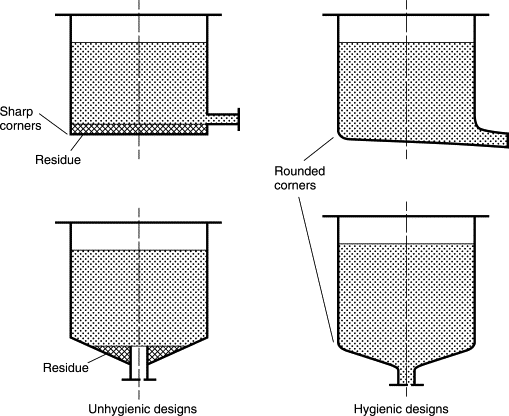
Reference: https://www.sciencedirect.com/science/chapter/edited-volume/pii/B9780857094292500048
Environmental Control
Standing water creates ideal conditions for microbial growth. Pathogens like Listeria monocytogenes thrive in wet environments. Floors are engineered with precise slopes to ensure drainage and prevent persistent moisture.
Good design reduces dependence on aggressive sanitation and improves reliability.
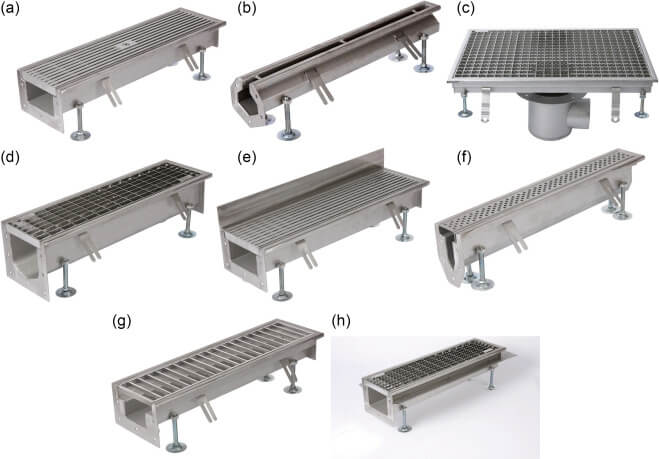
Reference: https://www.sciencedirect.com/science/article/pii/B9780128226186000162
Validation and Verification: Trust, but Verify
How do professionals know a sanitation process actually works? They rely on two distinct steps.
Validation: Will This Work?
Validation happens before routine cleaning begins. It is the scientific proof—often supported by studies and trials—that a specific process can achieve the required log reduction under defined conditions.
Verification: Did It Work Today?
Verification is the daily reality check. Common tools include:
- ATP bioluminescence swabs to detect organic residue
- Chemical test strips to confirm correct sanitizer concentration
- Visual and procedural checks to ensure steps were followed
Validation builds confidence. Verification builds consistency.
Biofilms: The Persistent Sanitation Challenge
Biofilms represent one of the most formidable enemy in sanitation. These structured microbial communities produce a protective matrix that shields bacteria from heat and chemicals. In many cases, disinfectants simply bounce off the surface.
Sanitizers alone are often ineffective against intact biofilms. The solution requires mechanical shear stress, scrubbing, turbulence, or pressure to disrupt the protective layer and expose bacteria to chemical action.
This reinforces a core principle: chemistry cannot compensate for missing mechanical action.
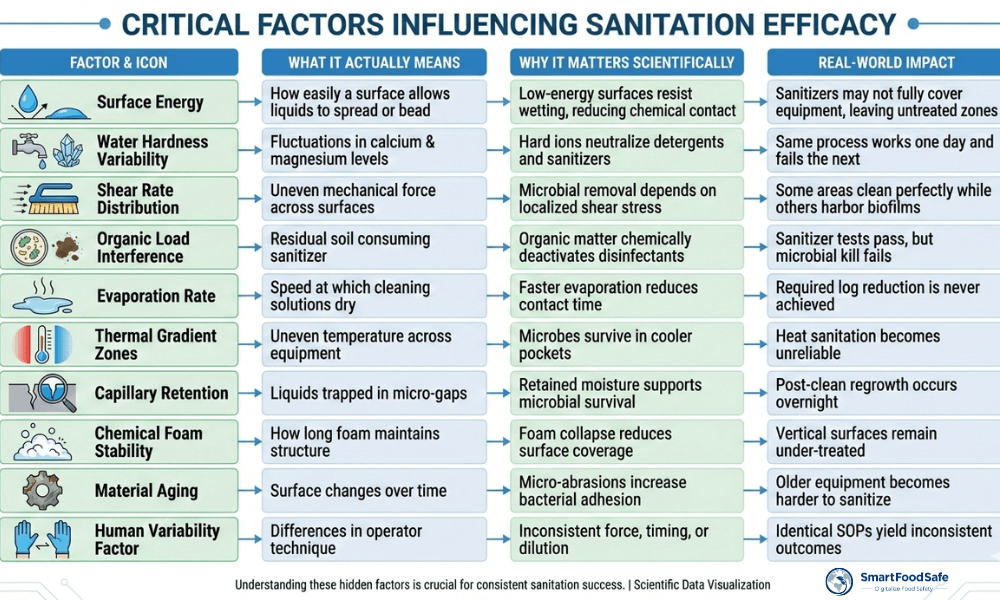
These factors explain why sanitation can fail even when SOPs are followed.
Clean Is a Controlled Scientific Outcome
Cleaning is an art of effort, but sanitation is a discipline of precision. We must look past the visible shine to the molecular reality beneath. When you align chemistry, temperature, and design, you gain something more valuable than a tidy space—you gain total control. Don't just clean with intent; verify with data. Mastery of the Sinner’s Circle isn't just about hygiene; it’s about the peace of mind that comes from knowing, with absolute certainty, that your environment is secure. Understanding soil behavior, selecting appropriate chemicals, designing equipment for cleanability, and verifying results through measurable tools are essential controls.
And in environments where safety matters, predictable clean is the only clean that counts.